The Monkey Paw in the Jira Ticket
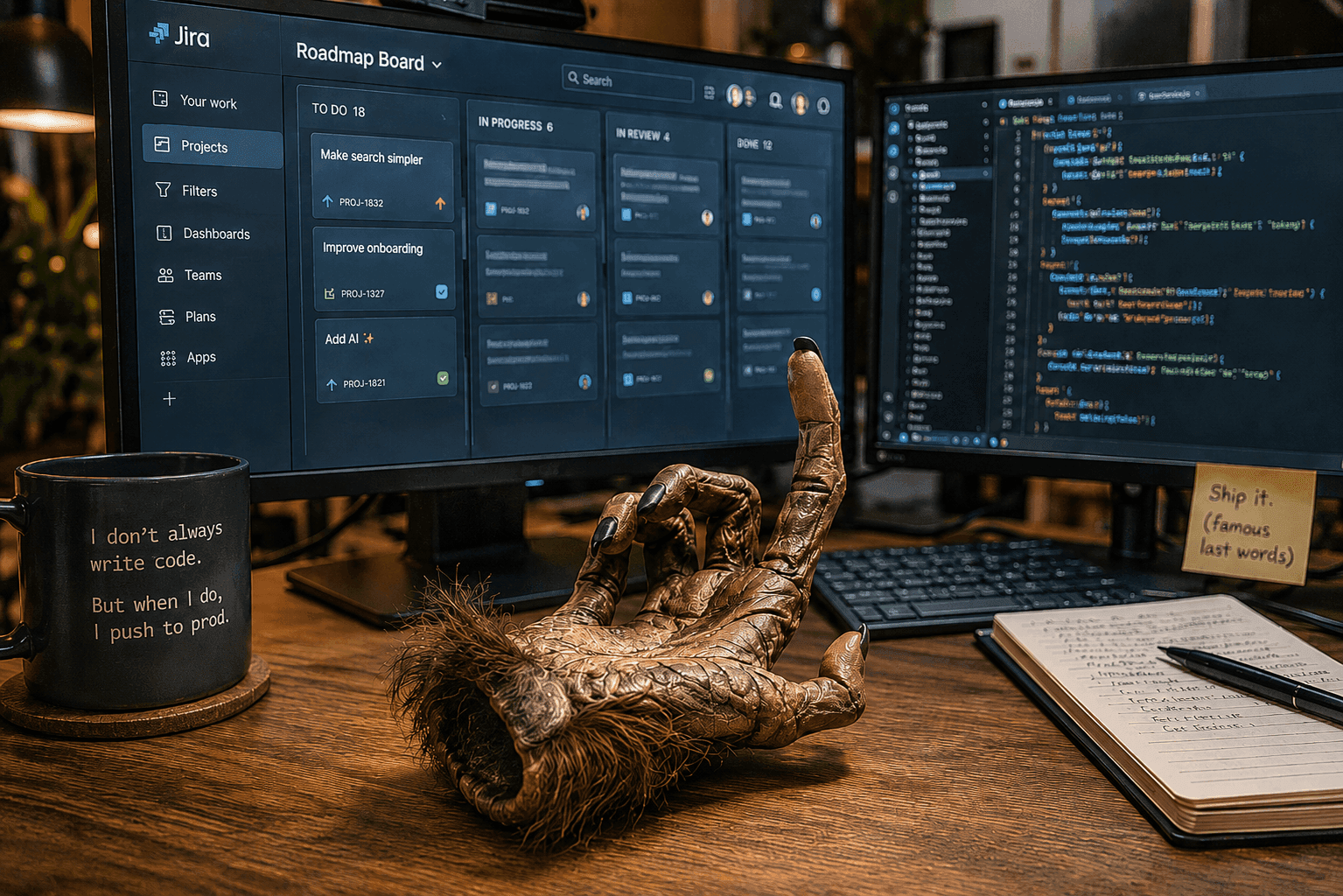
Everybody thought it was obvious
It's funny which travel stories survive.
I’ve climbed mountains. Swum with whale sharks. Even watched volcanoes erupt.
Yet somehow the story I tell most often happened in a Beijing alleyway over dinner.
We were wandering the hutongs and I asked if we could find something vegetarian to eat. I was tired of chewing on random gristle only to discover afterwards that I'd eaten a dog, a scorpion, or something equally alarming.
Our guide had settled on some barbecue. They served assortments of leaves and mysterious cubes on sticks.
This was one of her favourite places and I trusted her blindly to order for me. At this point my Mandarin was non-existent.
She handed me a skewer and I popped a cube in my mouth without thinking. Immediately I could tell something was wrong. Red alert wrong.
It crumbled in my mouth and then glued itself to my tongue. The flavour was spreading across my palate like a shockwave.
I was gagging.
I desperately wanted it out of my mouth but it had somehow embedded itself in my teeth.
It was like eating someone else’s nosebleed.
Sickening.
Why would she feed me that?
I confronted my poisoner.
“What the hell was that?!”
“Erm…” She grasped for the English translation. “Duck blood.”
“What? Why? I asked for something vegetarian!”
She looked genuinely perplexed.
“What? It’s not meat.”
It was then that I realised she hadn't deliberately tried to stitch me up.
She thought she understood exactly what I wanted.
I thought I'd been perfectly clear.
Somehow we'd both walked away from the same conversation with completely different ideas in our heads.
Be careful what you wish for...
That night in Beijing showed me how people can hear the same words and mean completely different things.
What took me a little longer to realise is that the same thing happens with facts.
In the summer of 2026 a runaway pop culture phenomenon seemed to come out of nowhere. A Gen Z filmmaker from the YouTube world released a low-budget movie about one of the oldest tropes in storytelling: the monkey paw.
You make a wish that seems perfectly clear and harmless.
The wish gets granted.
What could possibly go wrong?
I just want this person to love me more than anyone else in the world.
That's the premise of Obsession.
It's a horror movie, so I don't think I need to explain what happens next.
Interestingly, most of the online discussion revolves around the character of Nikki.
The conversations aren't just about the incredible performance of actress Inde Navarrette. They're about what Nikki wanted in the first place.
Was she romantically interested in her admirer before the curse?
To me, the answer feels obvious.
The clues all seem to point in the same direction: the creepy poem she recites at the party, the way the real Nikki occasionally leaks back through the curse, the confusing and contradictory ways she behaves.
Yet plenty of viewers disagree.
They look at the same scenes and reach a completely different conclusion. In their reading, Nikki wanted her captor all along. The real horror isn't the lack of desire. It's the loss of control.
What fascinates me is that both sides are using the same evidence.
Nobody missed a scene.
Nobody watched a different version of the film.
Both groups looked at exactly the same information and walked away convinced their interpretation was obvious.
At least until they heard the other side explain theirs.
Cursed computers
One of the things I like about software is that computers don't misunderstand you.
Not really.
They might do something unexpected. They might expose assumptions you didn't realise you'd made. They can faithfully execute a spectacularly bad idea.
But they are still following instructions.
Computers are logic machines. Every behaviour is the direct consequence of some rule, condition or command buried somewhere in the system.
If the outcome is strange, it's usually because the instructions were strange.
The monkey paw doesn't grant the wish you meant.
It grants the wish you asked for.
Software is exactly the same.
As developers we're constantly translating human requests into machine instructions. And that's where things get dangerous.
The computer isn't the weak link.
Long before a line of code is written, somebody has to explain what they actually want.
Debugging problems is almost always an exercise in exposing invisible assumptions.
The hardest misunderstandings to spot are the ones where everyone thinks they're already in agreement.
Few moments in software are quite as humbling as discovering the app was doing exactly what you asked it to do.
It was just behaving exactly as designed.
Looking back, my guide in Beijing wasn't wrong.
Duck blood isn't meat.
The problem was that we'd both assumed the other person meant the same thing when we said "vegetarian”.
Neither of us realised there was a misunderstanding until it was already stuck in my teeth.