You’re Not Listening
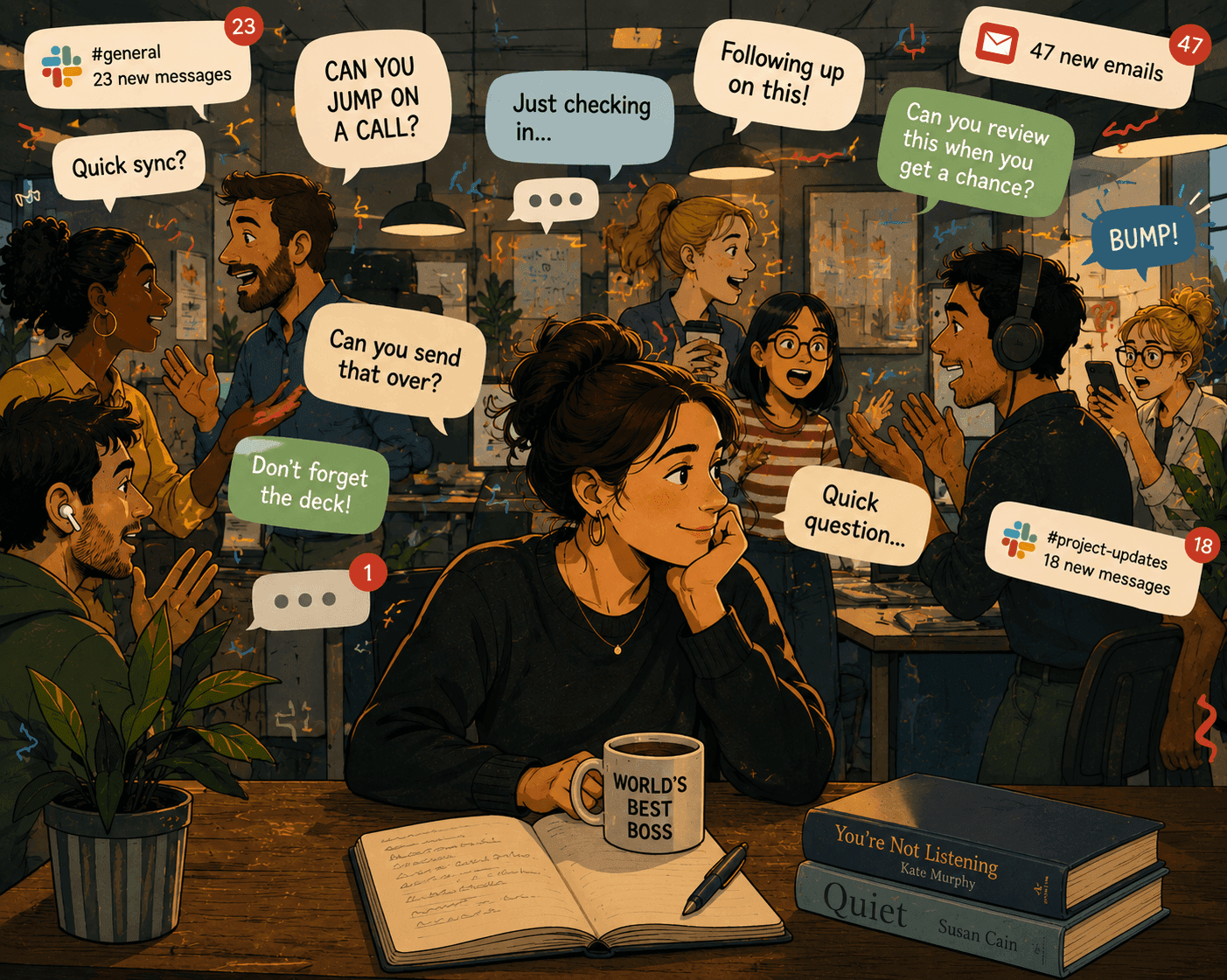
The skill nobody told engineers about
I stopped reading and felt sick.
I felt exposed.
Every page seemed to describe behaviours I recognised in myself.
Was I really this bad at communicating?
Had entire relationships quietly deteriorated because of it?
My whole life story suddenly felt like a beautiful lie I’d been telling myself.
I felt like a forty-year-old man suddenly discovering Santa Claus isn’t real.
The book was You're Not Listening by Kate Murphy.
And part of me thinks every teenager should probably read it.
Especially if they want to work in tech.
Just Slack me
We’ve all worked with the colleague who machine-guns their debugging problems into Slack.
The tapity-tap notifications start going off like popcorn.
You haven’t even responded to the first message before they’ve fired a second, third and fourth into the channel.
It’s almost like these tools were designed to talk at people instead of with them.
Everyone is frantically trying to get their thoughts out before the other person presses Enter and breaks their flow.
Then there are pull requests.
I know I’m not the only engineer who gets irrationally defensive when someone critiques the PR I spent a week carefully preparing.
And meetings?
How many of those have you walked into already knowing exactly what everyone is going to say?
We’re not really listening.
We’re just waiting for our turn to speak.
These aren’t conversations.
They’re pre-prepared speeches that were always going to happen regardless of what anyone else in the room says.
Which is strange when you think about it.
These tools were supposed to improve communication.
Yet somehow they often seem to amplify the exact opposite.
But maybe the problem isn’t Slack, WhatsApp or Discord.
Maybe it’s us.
You know nothing, Jon Snow
Want to hear something unsettling?
Multiple studies suggest that even with the people closest to us, our accuracy when guessing someone else’s actual thoughts or intentions maxes out at roughly 35%.
One in three.
We’re wrong about other people twice as often as we’re right.
And with strangers the numbers get even worse.
Suddenly human communication starts looking a lot more fragile than we’d like to admit.
Those assumptions we carry around are basically earplugs.
Thinking you already know what someone is going to say is a blindfold.
More than half the time, you’re not really having a conversation with another person at all.
You’re having one with your own projection of them.
I've had full-blown arguments with people over nothing more than a turn of phrase.
Maybe Ygritte was right about Jon Snow after all.
Two ears, one mouth
Some professional environments can accidentally reward terrible listening habits.
Tech is probably the textbook example.
We interrupt.
We solutionise too quickly.
We mistake waiting to speak for listening.
We walk into meetings already emotionally attached to our own ideas.
And somewhere along the line, communication quietly becomes performance instead of curiosity.
One of the most important things I took from You're Not Listening was the idea that understanding and agreement are not the same thing.
You can understand someone without sharing their conclusion.
That changes conversations completely.
It changes relationships too.
Suddenly silence stops feeling threatening.
Questions become more important than answers.
Meetings stop feeling like verbal chess matches.
And occasionally you leave a conversation with a fundamentally better idea than the one you walked in with.
I think we already spend enough of our lives with headphones on.
We’ve heard our own song plenty of times already.
Maybe it’s time to listen to someone else’s for a while.