Just Keep Walking
What mountaineering taught me about learning difficult things
It’s freezing. Bitterly, brutally cold.
My neck buff has frozen to my face and my Camelbak isn’t filled with water anymore. It’s a crunchy ice slushy now, and drinking it somehow makes you feel even colder.
The altitude leaves you breathless. Everything seems far away and somehow sharper than it’s ever been at the same time.
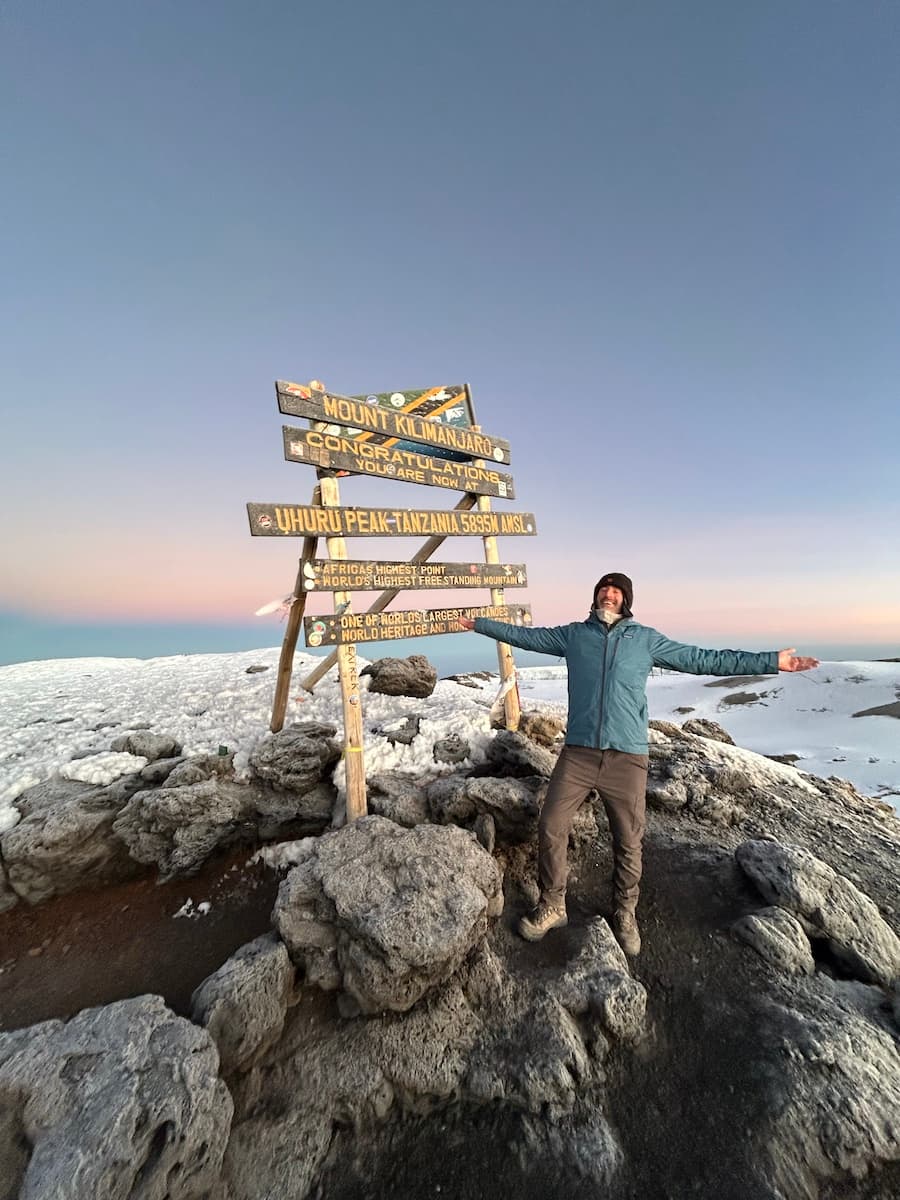
The sun is just starting to break over the horizon and the snow-covered landscape glows gold.
This might just be the greatest moment of my life.
I hug my fellow climbers in pure euphoria.
I’m standing at 5,895 metres.
This is the summit of Mount Kilimanjaro.
The Roof of Africa.
Who even does this?
Looking back, I think I’ve been obsessed with mountains since I was a kid.
My parents took us to the Bavarian Alps on a family holiday and I spent most of the trip telling my dad I wanted to “eat the clouds”.
Since then I’ve built as many holidays as possible around mountains. Peru. Canada. Japan. India. The list goes on.
But I never thought I could become a mountaineer.
People like Edmund Hillary and Tenzing Norgay felt closer to myths than actual human beings.
In a way, I thought the same about code.
Programmers were just smarter than the rest of us.
Talking to a computer on its own terms seemed to require a special kind of brain. One I didn’t have.
But eventually I realised something important.
Most of these people aren’t uniquely talented at all.
Mountaineers and programmers alike.
Most of them simply kept going after everyone else convinced themselves they couldn’t.
Don’t Look Up
The Kilimanjaro climb was all about tiny steps.
The guides kept saying, “Eat the elephant, Alex.”
Small bites over a long enough timeline and you can handle something enormous. I guess there aren’t many vegetarians in Tanzania.
The important thing was to stay calm.
Before summit day had even started I remember having a mild panic attack because I couldn’t find my glucose tablets. I was too focused on the enormity of what was ahead of me.
Eight hours climbing through the night.
Altitudes I’d never reached before.
But the panic disappeared the moment we started walking.
Everything was fine so long as I didn’t look up.
Or down, for that matter.
I just focused on my next step.
And strangely, that’s how most difficult things in life seem to work.
Focus on the act of walking instead of the summit and suddenly you’re higher than Everest Base Camp with plenty left in the tank.
You Can’t Summit Through Hype
A lot of beginners seem to think discomfort means: “I can’t do this.”
I’ve seen the same thing with junior developers throughout my career. Some look genuinely confused when I tell them I’m glad they’re struggling.
That’s what growth feels like.
Mountains teach respect for complexity and consequences.
The people most likely to suffer from altitude sickness are often overconfident young men who try to overpower the mountain from the very beginning.
You can’t summit through hype or showmanship.
You do it through pacing. Preparation. Calmness. Consistency.
Honestly, building software isn’t that different.
The mountain doesn’t care how confident you sound.
Tiny steps
Standing on the summit of Mount Kilimanjaro felt surreal.
Not because I’d conquered a mountain.
But because years earlier I would have looked at someone standing there and assumed they were fundamentally different from me.
Tougher. More fearless. Built for things I wasn’t built for.
But most difficult things in life aren’t reserved for special people.
They’re usually just the result of ordinary people staying calm long enough to keep taking the next step.
Tiny steps.
Eat the elephant.
Don’t look up.